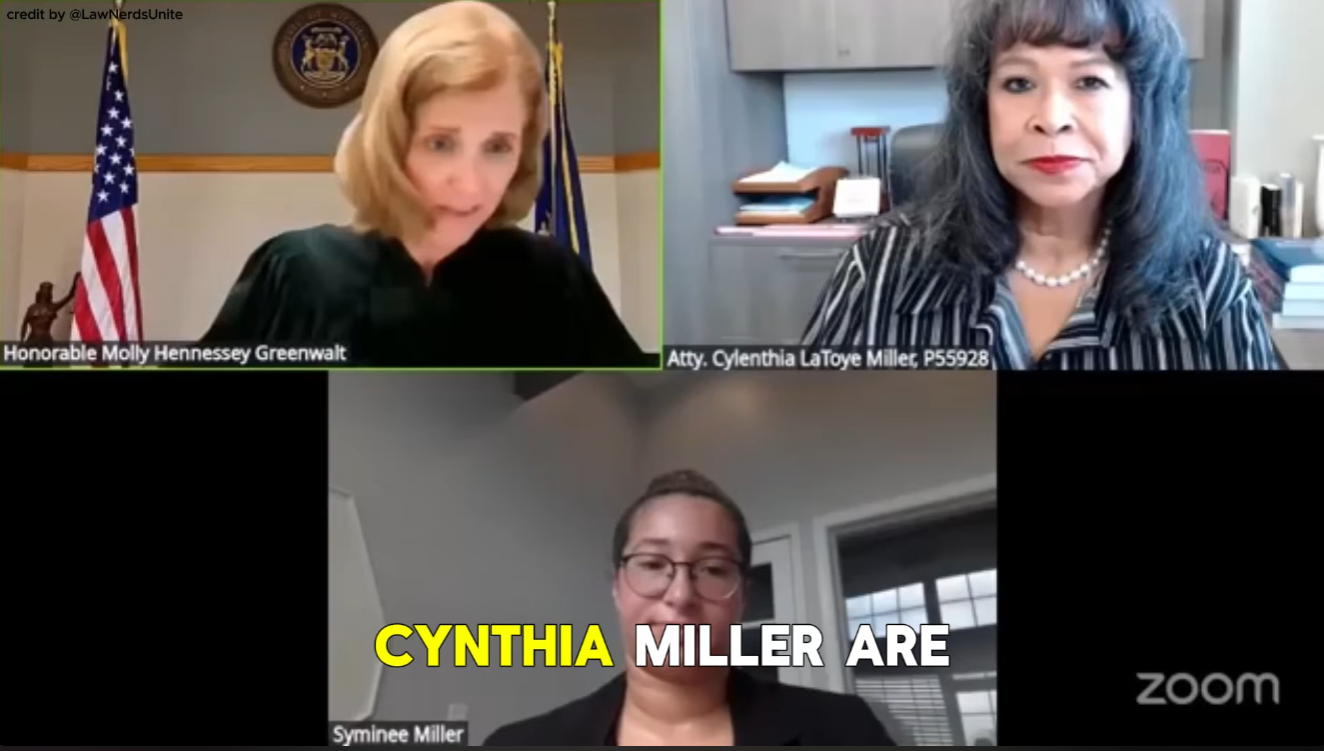
EAST LANSING, MI — A Michigan Circuit Court judge is facing a formal investigation by the State Bar after she was caught attempting to illegally act as an attorney for a family member during a virtual court hearing.
The dramatic confrontation, which unfolded during a routine Zoom arraignment, has sparked intense discussion online regarding judicial ethics and accountability.
An Unexpected Appearance
The incident occurred during a scheduled arraignment for a defendant facing Driving While Intoxicated (DWI) charges in the East Lansing District Court.
What should have been a standard legal proceeding took a sharp turn when Cynthia Latoya Miller, a sitting Michigan Circuit Court judge, logged into the Zoom call. Stepping into the attorney’s box, Judge Miller announced her appearance on behalf of the defendant, whom she described as a former ward and “like a daughter” to her.
However, her attempt to intervene was immediately halted by the presiding judge, Judge Greenwalt. Spotting a severe ethical conflict, Judge Greenwalt asked her directly: “Cynthia Miller, are you a sitting judge?”
“I am,” she replied.
With those two words, the hearing shifted from a routine traffic violation into a high-stakes confrontation over judicial misconduct.
The Law is Clear
Under Michigan law (specifically statute MCL 600.562), sitting Circuit Court judges are strictly prohibited from practicing law or appearing as an attorney in any court within the state. This legal boundary exists to prevent active judges from using their status, authority, or professional relationships to exert undue influence over prosecutors, clerks, or other judicial staff.
While judicial ethics opinions permit active judges to provide unpaid legal advice and counsel to family members behind closed doors, they are explicitly barred from acting as advocates, negotiating with prosecutors, or making official court appearances.
Judge Greenwalt did not hesitate to enforce the rule, stating on the record: “I am not moving forward with you attempting to represent [the defendant] here today.”
The “Paper Trail” Exposed
As the confrontation escalated, Judge Miller attempted to walk back her actions. She apologized to the court, claiming she believed she was allowed to provide limited representation to immediate family. She cited financial strain following the recent passing of her mother as the reason she was trying to resolve the matter quickly with the prosecutor without hiring outside counsel.
However, Judge Greenwalt quickly dismantled the defense, pointing out that her actions prior to the hearing showed deliberate intent rather than an honest mistake.
Greenwalt revealed that Miller had logged into the system under the title “Attorney Cynthia Latoya Miller”—omitting her judicial title. Furthermore, court chat logs showed she had been persistently messaging the court coordinator before the hearing started, actively trying to secure a back-channel meeting with the prosecutor.
“The appearance of impropriety… using your office to speak with the prosecuting attorney,” Judge Greenwalt noted, emphasizing that her unique attorney identification number would have immediately signaled her judicial status to the prosecutor, creating an unfair power imbalance.
A Definite Dismissal
Refusing to tolerate the breach of ethics, Judge Greenwalt ordered the sitting judge to leave the virtual courtroom.
“I am going to ask you to leave our Zoom. It’s not a request,” Judge Greenwalt asserted, adding, “I’m sorry to say, and I have a duty now to report this to the State Bar.”
Judge Miller was subsequently disconnected from the hearing. The defendant’s arraignment was adjourned to allow her time to secure proper, lawful legal representation through a public defender or private counsel.
The incident serves as a stark reminder of the strict ethical standards governing the judiciary. As public trust in the legal system remains a critical pillar of justice, the swift actions of Judge Greenwalt have been widely praised as a necessary check on judicial overreach.