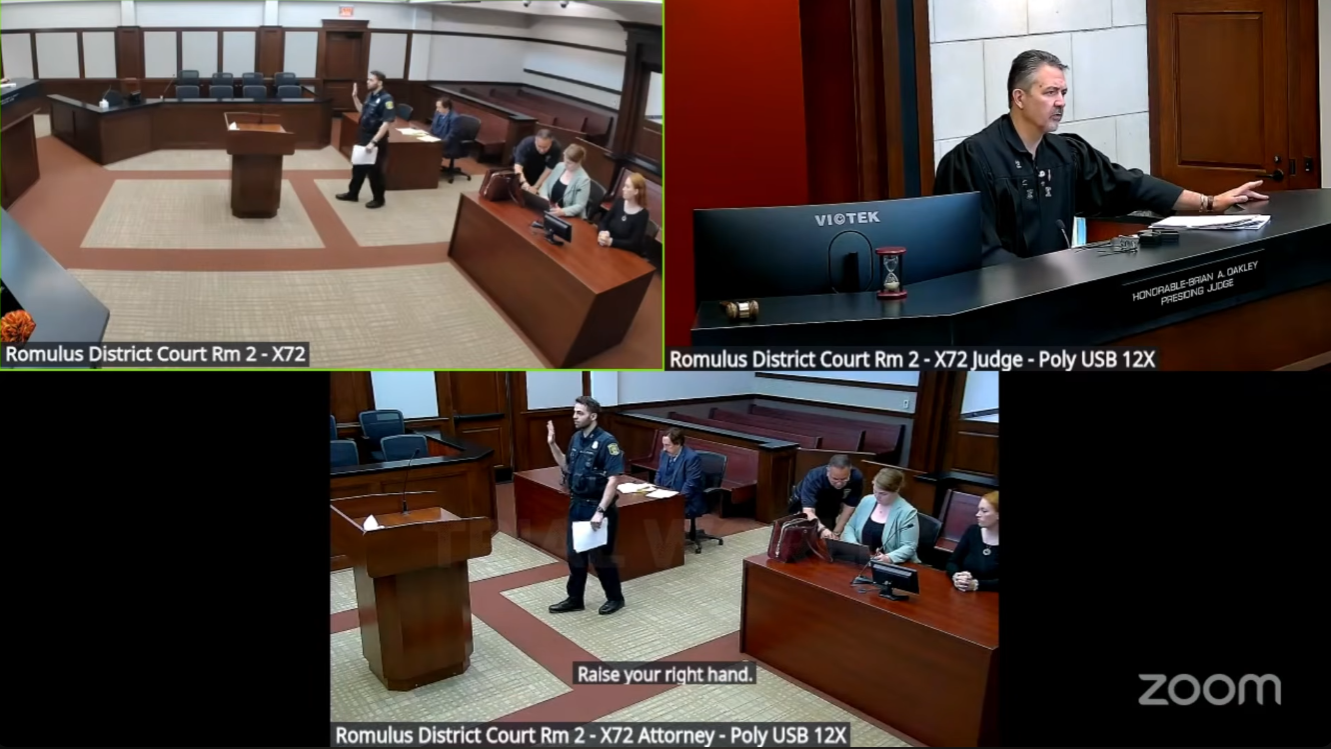
ROMULUS, MI — A Michigan district judge has dismissed a drug possession case in its entirety, ruling that police officers did not have probable cause to initiate the traffic stop that led to the defendant’s arrest.
The decision serves as a significant legal reminder of the Fourth Amendment’s protections against unlawful search and seizure, proving that even a successful search can be thrown out if the initial stop is deemed illegal.
The Stop and Subsequent Arrest
The case stemmed from an incident on December 19, 2025, in Romulus, Michigan. Officers Abdullah Moheisen and Chris Rain of the Romulus Police Department pulled over a 2012 silver Ford Focus driven by Cassandra Ira.
According to the officers’ testimony, the vehicle was stopped solely because the rear windshield was obstructed with items, which they believed blocked the driver’s rear visibility.
Upon approaching the vehicle, the officers ran Ira’s information through the Law Enforcement Information Network (LEIN) and discovered her driver’s license was suspended. Since driving on a suspended license is an arrestable offense under department policy, Ira was placed in handcuffs and secured in the back of the patrol vehicle.
During a subsequent search of the vehicle, officers discovered plastic baggies containing controlled substances inside a purse on the passenger side. Ira was subsequently charged with felony narcotic possession.
The Legal Loophole: Michigan’s Mirror Statute
The defense launched a highly effective challenge to the prosecution’s case by focusing on the legality of the initial traffic stop.
The defense counsel cited Michigan Compiled Law MCL 257.709, which governs vehicle window obstructions. The statute clearly states that a person shall not drive a motor vehicle with an obstructed rear window unless the vehicle is equipped with two exterior side mirrors (one on each side) to ensure adequate rear view.
During cross-examination, the defense pressed Officer Rain on the condition of Ira’s vehicle. Rain testified that the car was operating fine and, as far as he knew, it possessed all its side mirrors.
Under established constitutional law—specifically the landmark Supreme Court case Whren v. United States—police must have probable cause that a traffic infraction has actually occurred to justify a stop. Because Ira’s vehicle had functioning side mirrors, driving with an obstructed rear window did not constitute a civil infraction. Therefore, the police had no legal grounds to pull her over.
“Dismissed”
The prosecution argued that regardless of the mirror statute, driving with a blocked rear window is a dangerous safety hazard that could lead to accidents, justifying the stop under public safety interests.
However, the presiding judge quickly rejected this argument with a practical observation. “I drive an F-150 with a cap on the back and I can’t see spit out of my window other than headlights at night,” the judge remarked.
Because the initial traffic stop violated Ira’s Fourth Amendment rights, all evidence seized during the subsequent search—including the narcotics—was deemed inadmissible under the “fruit of the poisonous tree” doctrine.
With the evidence suppressed, the judge dismissed the entire case, concluding, “Good police work doesn’t always end up with convictions.”